
It's 3 pm, you've been sitting at your desk for hours – and suddenly it twinges. That dull pain in the lower back that slowly creeps upwards. Or the pulling and stabbing between the shoulder blades that makes typing hard. Sound familiar?
Back pain is the most common cause of sick days in Germany. Office jobs are particularly affected: long periods of sitting, static postures and a screen at the wrong height are a dangerous combination for the spine and muscles.
5 exercises against office back pain
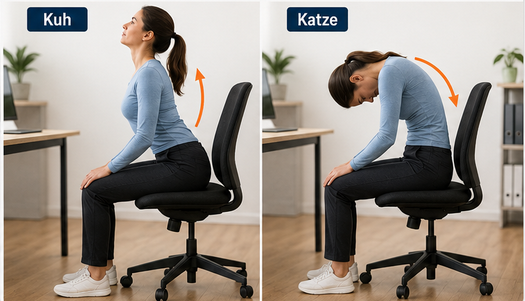
Exercise 1: cat-cow (spinal mobilisation)
Sit upright on the edge of your chair, feet hip-width apart on the floor. Breathe in deeply, arch your back, lift your chest and draw your shoulders back (cow). As you breathe out, round your back, pull your belly in and let your head drop (cat). 10 repetitions, slowly and with your breath.
Effect: mobilises the whole spine, releases tension, improves blood flow to the discs.
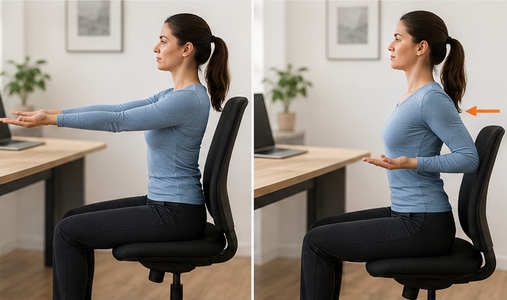
Exercise 2: shoulder blade retraction
Sit upright. Stretch both arms out in front of you, palms up. Now pull both elbows back as if squeezing something behind you – the shoulder blades move towards the spine. Hold for 5 seconds, then release. 15 repetitions.
Effect: strengthens the rhomboids (deep back muscles), opens the chest, corrects the “rounded back” typical of office work.
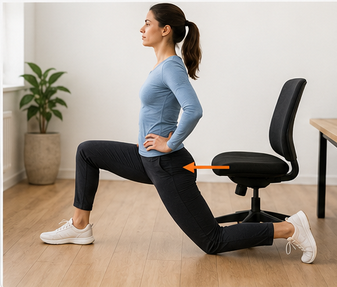
Exercise 3: hip flexor stretch in a lunge
Stand up and place one foot in front of your chair. Sink slightly into your knees (like a half lunge) and push your hips slightly forward until you feel a stretch at the front of the back hip. Hold for 30 seconds, switch sides.
Effect: the hip flexor (iliopsoas) shortens with long periods of sitting and pulls on the lumbar spine. This stretch is one of the most effective measures against low back pain.
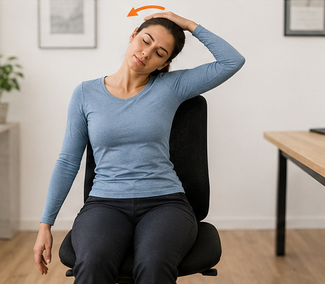
Exercise 4: neck side bend with breathing
Sit upright. Let your left arm hang loosely beside the chair. Slowly tilt your head to the right until you feel a stretch on the left side of your neck. Breathe in deeply – and as you breathe out, sink a little deeper into the stretch. 5 breaths, switch sides.
Effect: releases tension in the side of the neck and the trapezius – a common source of headaches with office work.
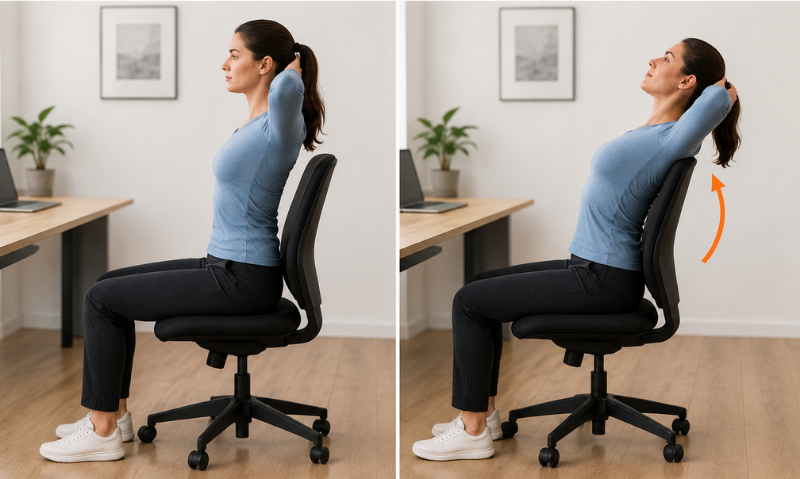
Exercise 5: thoracic extension over the backrest
Move forward a little on your chair. Place both hands behind your head and slowly lean back over the top of the backrest – your upper back (thoracic spine) rests over the backrest. Breathe in deeply and let the weight of your upper body do the work. 5–8 breaths.
Effect: mobilises the stiff thoracic spine, which often locks up with office work. The effect is often noticeable immediately!
How often should I do these exercises?
Ideally: a short 2–3 minute break every hour with 1–2 of these exercises. Set a reminder on your phone. Your back will thank you.
We also recommend:
- Stand up and walk a few steps at least twice a day
- Position your screen at eye level
- Alternate with sitting on the edge of your chair (active sitting)
- Really use your lunch break to move – a 10-minute walk is enough
💼 Back pain that won't go away? We can help!
Exercises are a good start – but persistent or severe back pain needs individual analysis and treatment. Our team in Rostock's Altstadt and Südstadt finds the cause and makes a plan that really works.
When to see a physiotherapist?
These exercises help with mild, acute tension. A physiotherapist makes sense when the pain lasts longer than 3 weeks, radiates into the arms or legs, keeps coming back, or you are unsure what the cause is. In physiotherapy you get a thorough assessment, targeted manual treatment and an individual home exercise programme – tailored to your body and your everyday life.


